
19 Sep 2026
The Roles You Can't Fill Are a Fifteen-Year-Old Problem, and an Afternoon of Your Time
If you have ever had a technical position sit open for months while your local colleges graduate students who can't fill it, this is a story about why that happens and how cheaply it can be fixed. I just spent two days with Hidalgo County Workforce Solutions — the regional public agency that sits between employers, schools and job seekers — and by the end of them it was obvious I was sitting in the same conversation I'd sat in fifteen years ago. The gap between what our schools teach and what our employers are hiring for hasn't closed. It's gotten wider, and it's moved.
That matters to every kid in the Rio Grande Valley who is about to graduate into it. There are more people trying to fill more positions under the enormous umbrella we now call “information technology” — the whole category of jobs that build and keep running the computers, networks, software and data systems a business depends on — and the shape of those jobs changes every eighteen months. We've got two incredible institutions down here, South Texas College and UT Rio Grande Valley, both with outstanding academic programs and strong IT programs, and the students coming out of them still aren't filling the positions the business community is actually trying to hire for.
I forgot how much workforce development means to me, and two days was all it took to remember. Here's what those two days looked like, why a booth that stopped fifty students out of 1,500 was worth every minute, and what I'm asking you to do about it.
What the two days actually were
The Workforce Solutions team put together something genuinely impressive. Day one was focused on the IT segment in the Rio Grande Valley: what the sector needs, what it's looking for, what's available, and how we bridge the distance between those things. We held one of the biggest roundtables I've ever been part of down here — employers and educators in one room — all of it about what the future of work looks like for IT in the Valley.
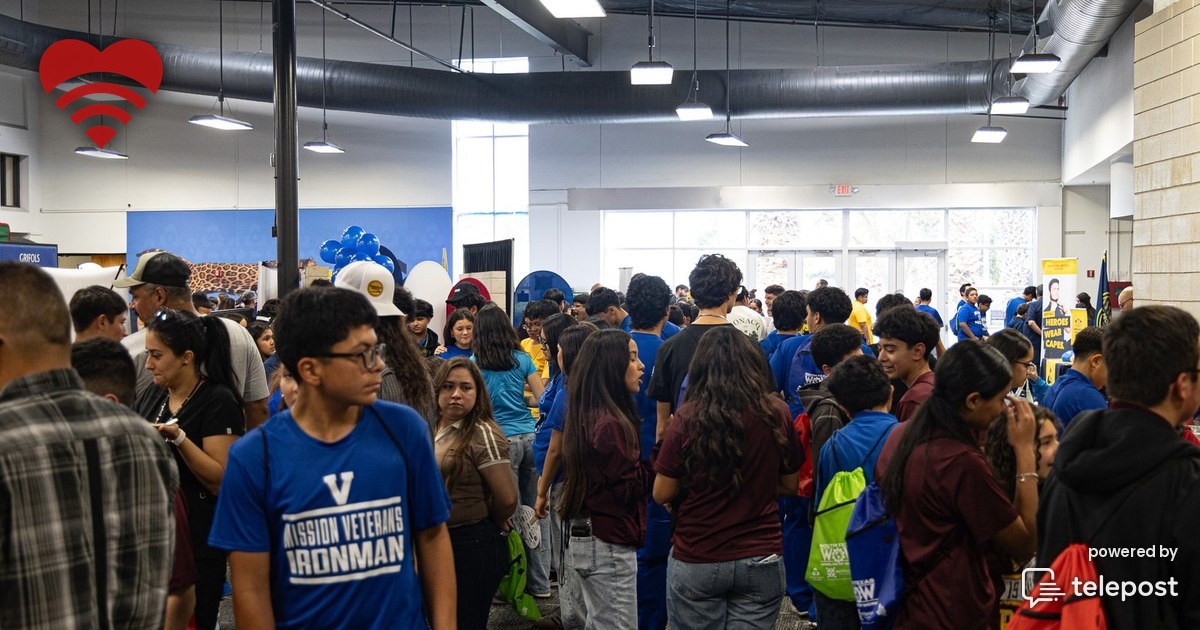
Day two was the World of Work, a job fair of sorts that Workforce Solutions put together in partnership with South Texas College. Vendors and employers came out of the woodwork, and eighth graders through twelfth graders cycled through all day. I set up a booth for Code RGV, the nonprofit I helped start, for the first time in five or six years.
After two days of talking to people in industry, people in education, people who genuinely care about this, the repetition was impossible to miss. That's the part that lit the fire. Not frustration. Recognition. We know how to do this. We've done it before. We just got stopped.
The model worked the first time, and then it stopped
About fifteen years ago, a few friends and I started a nonprofit to teach kids in South Texas how to code, how to build robots, how to be a technical nerd in a place where nobody told them that was an option. We held monthly meetings, we got sponsored by one of the largest beer distributors in the Valley, there was always free pizza, and there was always this incredible cross-pollination happening in the room — the kid who'd been soldering in his garage sitting next to the guy who ran a network operations center, the 24-hour room where a company watches its networks for failures, both of them realizing they spoke the same language.
That turned into grants from the State of Texas to help develop the workforce down here, and it worked. We placed 80% to 90% of the people who came through our programs into real opportunities. Even then, with both institutions running good programs, there was a gap between what was being taught and what was being asked for.
I should explain the five or six years I was gone. COVID did a number on us, and we lost our funding, and we lost our ability to take the work into the community, because the machine we'd built to do exactly that was gone. We called it the CAL, the Classroom on Wheels — an RV we'd converted into a mobile classroom so we could bring the program to neighborhoods instead of waiting for them to come to us. We took it in to get refurbished, and the guy doing the refurb had a midlife crisis in the middle of tearing apart our RV. We never got it back. We lost the whole thing.
Why only fifty out of 1,500 students stopped at my table
At the World of Work, about 1,500 students cycled through the space we were in, and maybe fifty of them came and talked to me. Part of that is because they were serving cookies right next door. But mostly it's because of what was on my table: access points (the boxes on the ceiling that broadcast Wi-Fi), spectrum analyzers (instruments that make the invisible radio traffic in the air visible, so you can find what's interfering with a network), and a Flipper Zero (a small handheld gadget hobbyists use to read and test everyday wireless signals, the kind of thing a curious teenager recognizes instantly). I told the Workforce Solutions folks straight up: the kids who know what's on this table are going to come over and talk to me, and the rest of them, this isn't their thing, and that's fine.
Then one student came over, and I felt something I hadn't felt in years, because I haven't been standing in front of anyone doing this. I forgot how incredible it is to watch a student light up because they're finally talking to someone who understands what they do. Who understands what they're into. Who takes their passion seriously instead of treating it like a phase.
He emailed me afterward, and I screenshotted it, because all it takes is reaching one student who could end up changing the world. Over the years there have been a handful of those. I'm not going to name names, but you know who you are, and watching that fire grow in you has been one of the best parts of my career.
So what?
Here's why I'm writing this instead of just posting a photo from the booth. What a kid gets out of a room like that isn't always a job — sometimes it's just a conversation, and sometimes it's a guy showing off a piece of cool technology to a kid who didn't know anybody else on earth knew what it was. You can be that guy, and it costs you an afternoon.
A lot of us have been doing this for a long time. We've accumulated an enormous amount of knowledge, and many of us are getting to the age where the most valuable thing we can do with it is hand it off to people who will build better things than we did. Knowledge is only as good as how well you can transfer it. If it dies in your head, it wasn't worth much.
What you can do, whatever field you're in
- Go volunteer. Go teach a class in your community — it does not have to be about technology.
- Go sit at a table with weird gear on it and wait for the one kid who recognizes it.
- Ask your hiring managers which roles have sat open longest, and whether anything in the local curriculum actually produces that skill.
- Ask whether anyone from your organization has ever sat at a regional workforce roundtable, and if not, find out when the next one is.
- Ask what it would take to sponsor one meeting: a room, some pizza, and two hours of somebody senior's time is roughly the whole model.
- If you fund things, ask a local program what a year of operating money looks like, and what capability they lost and never replaced.
As for us, Code RGV is getting back together, and we have the support of Workforce Solutions, which is no small thing. Now we need funding, and then we need to get back to work bridging the gap between our students and the jobs sitting empty in our own backyard.
Because the kids in deep South Texas deserve to be more than a demographic. More than a call center seat. More than a bilingual accent that somebody relocated here to take advantage of, and called a “skill set” while they did it.
Want this kind of thing weekly, in audio? That's the show.