
05 Aug 2026
Why Starlink's Rooftop Cell Hint Matters to Carriers
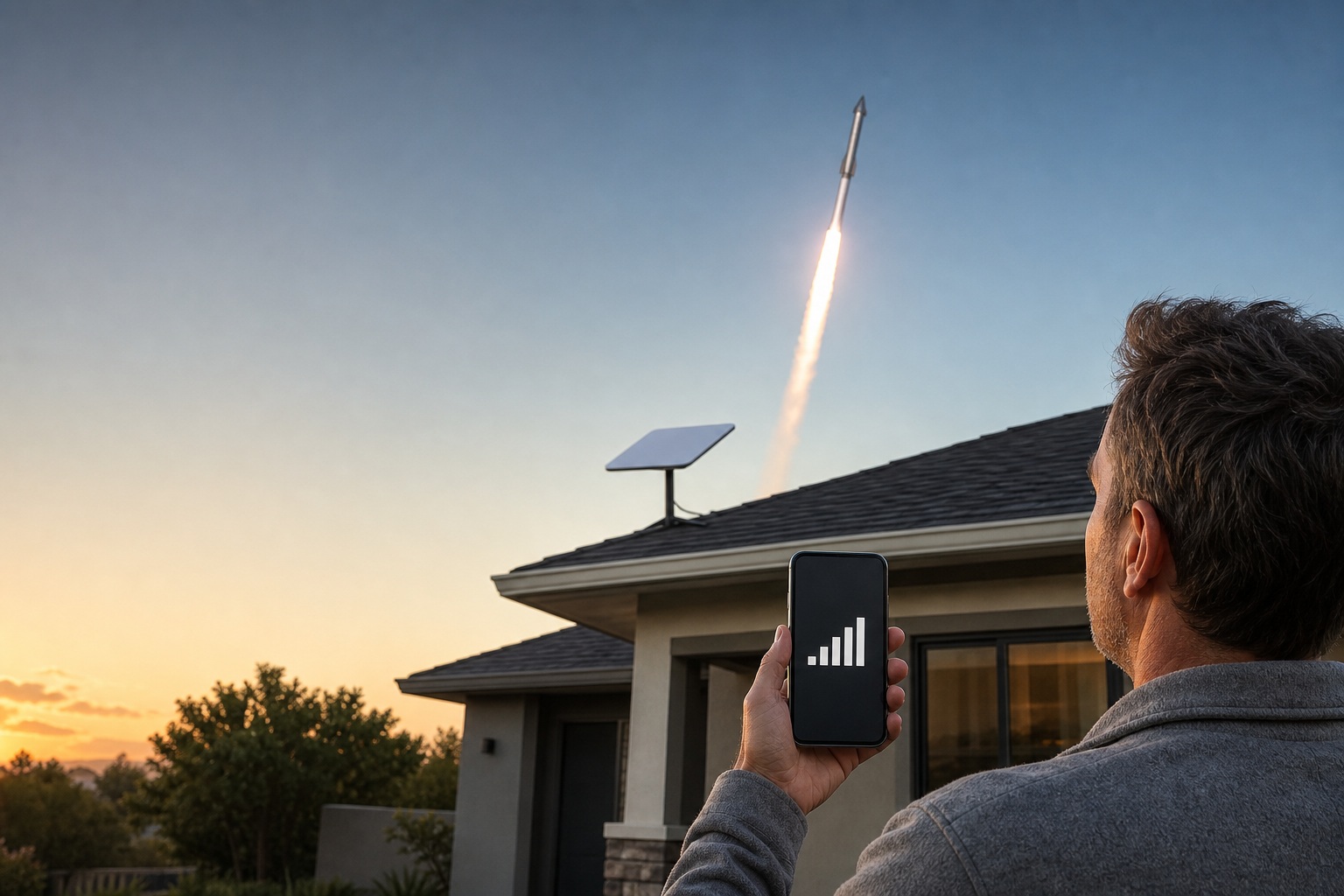
SpaceX did not announce a finished rooftop cell network. On its Q2 2026 earnings call, President and COO Gwynne Shotwell offered what she called "a little hint" about putting small cellular base stations on the mounts that already hold Starlink dishes.
What did SpaceX actually say?
TelecomTV quoted Shotwell directly:
"Let me give a little hint… you could put a cellular base station on the gear that holds a Starlink broadband dish. You can have little femtocells around the country, and you deploy that as you need it."
Elon Musk described many small stations built around Starlink dishes on homes and businesses. Shotwell said she expected the design to be "quite capex efficient," but SpaceX did not publish a terrestrial budget, product specification, deployment count, or launch date.
Why could this cost less than a normal cell network?
A traditional carrier acquires or leases locations, obtains permits, installs towers or poles, arranges power and backhaul, and maintains each site. SpaceX may be able to reuse some customer locations and its own satellite backhaul. That could lower part of the site cost, but it does not reduce the cost to $0. Radios, installation, customer consent, permits, maintenance, interference management, and network integration remain real expenses.
SpaceX's Q2 2026 results report 12.0 million Starlink subscribers, up from 6.0 million a year earlier. That is not 12 million cellular sites. It is a potential customer footprint that SpaceX might be able to use if the technical, commercial, and regulatory pieces line up.
What did Helium demonstrate?
Helium recruited individuals and businesses to host small radios, first using CBRS and later focusing heavily on Passpoint Wi-Fi offload. The important measurement is not the number of hotspots. It is how much carrier traffic moved through the network.
Messari's State of Helium Q4 2025 report says carrier offload reached 4,388 TB in Q4, up 60.7% from 2,731 TB in Q3. Cumulative offload reached 9,839 TB by the end of Q4. That is strong evidence of demand for offload capacity, but it does not prove that every deployed Helium radio delivered useful coverage.
Fierce Network reported that Noble Mobile acquired Helium Mobile's consumer operations in June 2026 while Nova Labs continued operating the Helium Network and carrier offload business. The lesson is that retail phone service and wholesale offload are separate businesses.
Does SpaceX need the big carriers?
For national retail phone service, SpaceX would need coverage beyond its own network. Analyst Tim Farrar told Light Reading that it would be "a big struggle to build a retail wireless business without any MVNO network access." The three national carriers have resisted a Starlink MVNO and announced a joint satellite venture.
Wholesale offload works in the other direction. A carrier pays another network to carry traffic where that capacity is useful. That still requires a commercial agreement, but it does not require the carrier to let SpaceX resell its nationwide network. SpaceX may not need to beat Verizon. It may need to become useful to Verizon.
Why does upper C-band matter?
The FCC voted on July 22 to clear 160 MHz of Upper C-band spectrum for auction. The order implements a law requiring an auction of at least 100 MHz to finish by July 4, 2027. Broadband Breakfast reported those details from the FCC meeting and linked the meeting video.
Compared with low-band spectrum, signals around 4 GHz generally have shorter range, so dense candidate locations can matter. A radio on the customer's roof changes the path into the building. Instead of asking a phone to reach a traditional tower through concrete, brick, stucco, and miles of clutter, a nearby rooftop radio could send signal down through the roof with fewer exterior obstructions. Its propagation would be roughly in the same neighborhood as 5 GHz Wi-Fi, although the roof, floor plan, interior walls, radio power, and antenna design would determine which rooms it reaches. SpaceX does not have 12 million ready cellular sites, but its customer footprint could provide more candidate locations than a new entrant normally starts with.
What does SpaceX's spending tell us?
The company's Q2 filing reports $7.81B in revenue and $18.37B in total capex. That included $15.83B for AI, $1.37B for connectivity, and $1.17B for space. The connectivity segment reported $4.29B in revenue and $1.66B in operating income. SpaceX also announced a $60B agreement to acquire Cursor.
Those numbers do not prove rooftop femtocells are the only design SpaceX can afford. They help explain why a terrestrial architecture that reuses customer relationships, possible locations, and company-owned backhaul could appeal to management instead of starting with a conventional tower build.
Where Passpoint and SignalRoam fit
A nearby rooftop cellular radio could improve the path into a home, and Passpoint could provide a second layer in rooms where roofing materials, floor plans, or interior walls still weaken that signal. Passpoint lets a compatible phone join a participating Wi-Fi network with credentials already provisioned on the device. The user does not have to choose a network or use a captive portal. If SpaceX or its partners establish the required roaming agreements, Passpoint could carry traffic over indoor Wi-Fi where needed.
SpaceX has not announced Passpoint or a relationship with SignalRoam. This is an existing option for solving part of the indoor coverage problem, not a claim about a signed Starlink product plan.
How fast does any of this happen?
This is a multi-year possibility, not a 6-month rollout. TelecomTV reported that SpaceX expects its next-generation mobile satellites to begin service by the end of 2027. The Upper C-band auction must finish by July 4, 2027, and the spectrum then has a transition and buildout schedule. SpaceX still has to convert the rooftop hint into a product and solve spectrum, devices, installation, interference, regulation, roaming, and operations.
Questions worth asking
- How would our tower, lease, or connectivity economics change if a competitor could reuse customer locations?
- Are we assuming SpaceX has 12 million ready cell sites when the company has only reported 12.0 million subscribers?
- Are we evaluating wholesale offload separately from the retail MVNO question?
- Who is tracking the Upper C-band auction, transition schedule, and final buildout rules?
- Could Passpoint let our existing Wi-Fi participate in indoor offload?
- Which parts of our plan come from an announced SpaceX product, and which are extrapolation from Shotwell's hint?
Sources and references
- SpaceX, Q2 2026 results
- TelecomTV, Starlink small-cell earnings-call coverage
- Light Reading, SpaceX mobile analyst coverage
- Broadband Breakfast, report from the FCC's July 22 Upper C-band vote
- Messari, State of Helium Q4 2025
- Fierce Network, Noble Mobile acquisition of Helium Mobile
- Wireless Broadband Alliance, Passpoint
Source
Want this kind of thing weekly, in audio? That's the show.