
05 Aug 2026
SpaceX's Rooftop Cell Hint Looks a Lot Like Helium's Network
▶ Listen to this article — read by Drew
SpaceX did not announce a finished terrestrial mobile network on its Q2 2026 earnings call, and Gwynne Shotwell called what followed "a little hint," which matters because everything beyond her comments is analysis rather than a product announcement.
My read is that the subscriber-hosted small-cell concept resembles parts of the community-hosted CBRS and Passpoint Wi-Fi architecture Helium spent years testing. Helium used HNT incentives to recruit hosts. SpaceX already has a large customer base, its own satellite backhaul, and 65 MHz from its EchoStar transactions. That does not make 12 million cell sites appear overnight, but it changes the site-economics question.
What did SpaceX actually say?
TelecomTV's report from the August 4 earnings call quotes Shotwell this way:
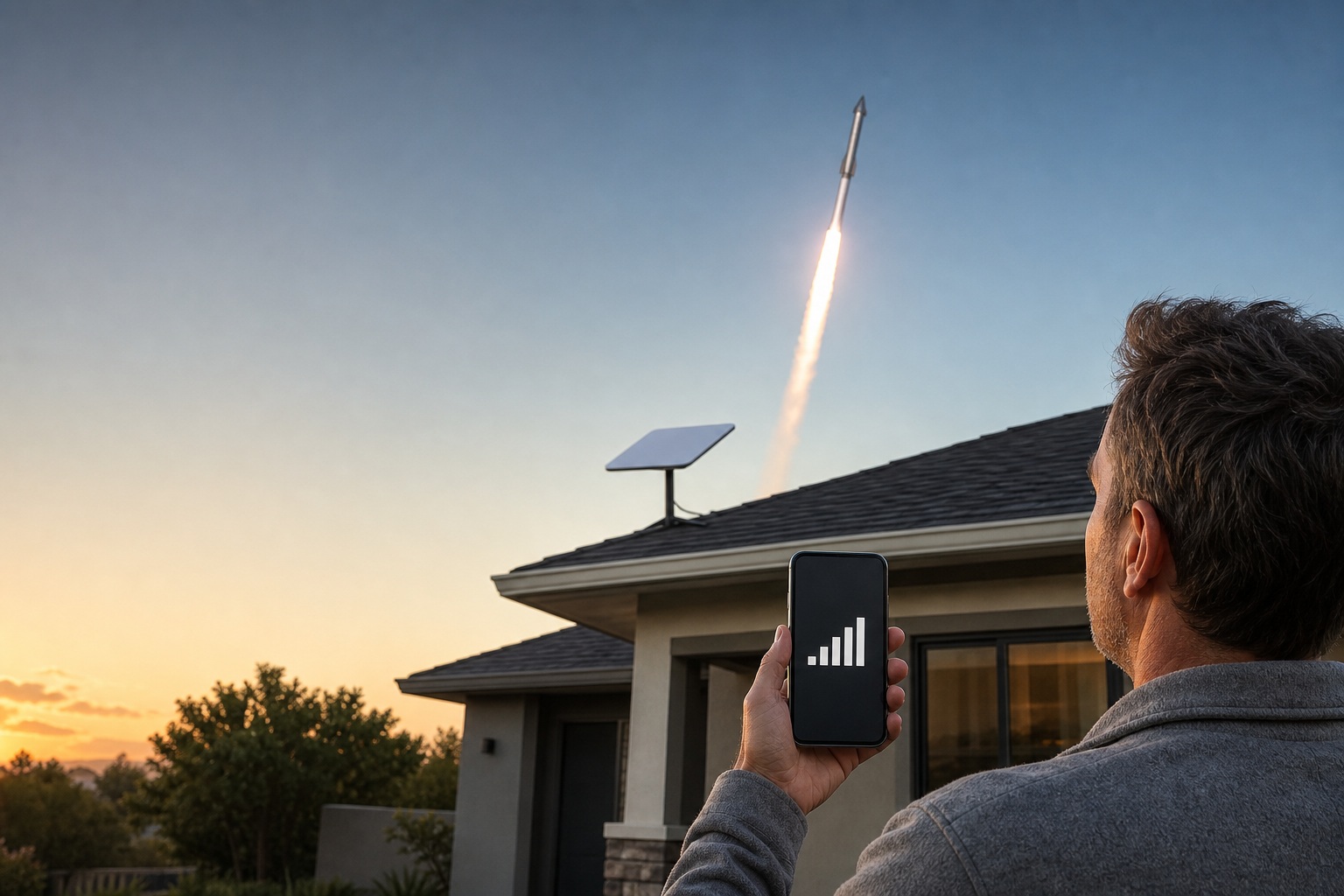
"Let me give a little hint… you could put a cellular base station on the gear that holds a Starlink broadband dish. You can have little femtocells around the country, and you deploy that as you need it."
Gwynne Shotwell, SpaceX President and COO
Elon Musk then described the same idea in more detail:
"Instead of having to deploy these very expensive and difficult-to-locate large cellular base stations, we feel reasonably confident that we can deploy a large number of small stations. They're really just Starlink dishes that also provide connectivity in the mobile spectrum bands and have them all over the place. The Starlink antennas are located on the roofs of houses and businesses, so they've got a sort of clear view for providing connectivity directly to cell phones on the ground."
Elon Musk, SpaceX CEO
Shotwell did not disclose a terrestrial buildout budget. Her exact claim was narrower:
"That's why I don't want to talk about the capex for building out the terrestrial, because we have a lot of really great and new ideas for how we're going to do that, and I think it will be quite capex efficient."
Gwynne Shotwell
The company's Q2 2026 results report 12.0 million Starlink subscribers, up from 6.0 million a year earlier. That is a subscriber count, not a confirmed count of rooftop dishes, suitable radio locations, permitted cell sites, or terminals that SpaceX can convert. I am treating it as a potential customer footprint, not 12 million ready-to-activate femtocells.
What are the skeptics actually saying?
Light Reading's Michelle Donegan reported that MoffettNathanson described SpaceX's direct-to-device ambitions as "quixotic." The analysts said the earnings-call comments did not change their assessment, including what they called:
"the relatively well-worn idea of a mesh network of rooftop 'femtocells'"
Tim Farrar of TMF Associates gave Donegan a more specific historical comparison. He called cellular antennas integrated into Starlink dishes "a direct copy" of Charlie Ergen's proposed Clearwire plan in 2013. Farrar said the most plausible additional purchase would be "EchoStar's CBRS spectrum" and added that it would be "a big struggle to build a retail wireless business without any MVNO network access."
Those are real objections. A customer terminal is not automatically a coordinated radio site. SpaceX would still face handset support, interference management, indoor penetration, power and mounting variation, local rules, network integration, and commercial roaming agreements. Helium's history does not erase those problems. It gives us operating data for one version of the model.
What did Helium actually demonstrate?
Helium began with CBRS radios and later leaned heavily into Wi-Fi offload using Passpoint. The useful proof point is not hotspot count by itself. Deployed radios do not equal usable coverage. The useful proof point is traffic that carriers were willing to place on the network.
Messari's State of Helium Q4 2025 report says carrier offload reached 4,388 TB in Q4 2025, up 60.7% from 2,731 TB in Q3. Messari reported 9,839 TB in cumulative offload through the end of Q4. That is evidence of demand for the offload network, not proof that every Helium hotspot delivered good coverage.
Fierce Network reported in June 2026 that Andrew Yang's Noble Mobile acquired Helium Mobile's consumer operations. Nova Labs continued operating the Helium Network and its carrier offload business. That separation is important. A retail MVNO buys access from a carrier. Wholesale offload sells capacity to carriers. Both require commercial agreements, but they are different agreements with money moving in opposite directions.
My blunt version from the interview was:
SpaceX doesn't need to beat Verizon. It needs Verizon to need it.
Is the missing MVNO still a problem?
Yes, if the goal is a national retail mobile service that works wherever Starlink has no terrestrial or satellite coverage. Light Reading reported that the three national carriers had resisted a Starlink MVNO arrangement, and the carriers announced a joint satellite venture. Farrar's retail warning should stay in the article because it is not answered by rooftop femtocells.
The wholesale question is different. If SpaceX can build useful capacity in places where a carrier wants relief, the carrier could buy offload without turning Starlink into its retail MVNO. That is the Helium comparison I care about.
Why does upper C-band matter?
The FCC voted on July 22 to clear 160 MHz of Upper C-band spectrum for auction. The order implements a law directing the agency to complete an auction of at least 100 MHz by July 4, 2027. Those confirmed figures are in Broadband Breakfast's report from the FCC meeting, which also links the meeting video.
C-band's propagation is the reason this becomes a site-economics story. In my view, signals around 4 GHz still make dense candidate locations valuable because they do not travel as far as low-band spectrum, but putting the radio on the customer's roof changes the path into the building. Instead of asking a handset to reach a traditional tower through concrete, brick, stucco, and miles of clutter, a nearby roof-mounted radio could pour signal down into the home through the roof with fewer exterior obstructions. Around 4 GHz is roughly in the same propagation neighborhood as 5 GHz Wi-Fi, although transmit power, antenna design, roofing materials, floor plans, and interior walls would determine which rooms it reaches. A Starlink terminal does not eliminate the engineering requirement, but it could give SpaceX a large pool of customer relationships and candidate locations from which to design a denser network.
That is softer than saying SpaceX has 12 million free cell sites, because it does not. The incremental site cost could be much lower than a traditional greenfield macro build, but it is not zero. Radios, installation, coordination, permits, operations, maintenance, and customer consent still cost money.
What does the capital allocation tell us?
The numbers are now in the company's own filing. SpaceX reported Q2 revenue of $7.81B and total capex of $18.37B. That capex included $15.83B for AI, $1.37B for connectivity, and $1.17B for space. The connectivity segment reported $4.29B in revenue, $1.66B in operating income, and $2.60B in adjusted EBITDA. SpaceX also announced a $60B agreement to acquire Cursor. All of those figures come from the SpaceX Q2 2026 results.
My conclusion is analysis, not something Shotwell said: when one segment receives $1.37B of capex while AI receives $15.83B, a capex-efficient terrestrial design becomes strategically important. That does not prove rooftop femtocells are the only architecture SpaceX can afford. It helps explain why management would emphasize a design that reuses customer locations and company-owned backhaul.
Where does Passpoint fit?
Passpoint is the second indoor layer in this argument. A nearby rooftop radio could improve the path into a house, while Passpoint could fill rooms where roofing materials, floor plans, or interior walls still weaken that cellular signal. It lets a compatible phone join a participating Wi-Fi network using provisioned credentials, without asking the user to select a network or work through a captive portal. If SpaceX enables Wi-Fi at participating customer or business locations and establishes the required roaming agreements, Passpoint could move supported devices onto indoor Wi-Fi where needed.
That is a conditional architecture, not an announced Starlink feature. SpaceX has not said it will use Passpoint, SignalRoam, or any specific Wi-Fi offload provider. I am pointing to an existing, deployed tool that addresses a limitation the rooftop concept still has to solve.
How fast does any of this happen?
I would not model a meaningful U.S. terrestrial rollout in the next 6 months. TelecomTV reported that SpaceX expects its next-generation mobile satellites to begin service by the end of 2027. The Upper C-band auction must finish by July 4, 2027, and the licensed spectrum still has a transition and buildout schedule after that. The timing points to a multi-year network story, not a switch SpaceX can flip this quarter.
The near-term product remains satellite direct-to-device coverage. The rooftop concept could become a terrestrial complement, but SpaceX still has to turn the hint into a product, obtain or deploy suitable spectrum, integrate radios with terminals, manage interference, and establish the commercial relationships needed for roaming and offload.
Do this
- Model tower economics against a competitor that may reuse customer locations, but do not assume its incremental site cost is $0.
- Track the Upper C-band auction, transition schedule, and final buildout rules directly in the FCC docket.
- Separate Starlink's retail MVNO problem from the wholesale offload opportunity. They require different agreements and produce different economics.
- Read Helium's carrier traffic data, not its hotspot count, before calling the distributed model proven or failed.
- Put Passpoint and indoor offload on the roadmap as a second layer for rooms where roofing materials, floor plans, or interior walls still weaken a nearby rooftop signal.
- Treat Shotwell's comments as a hint until SpaceX publishes product, spectrum, deployment, and regulatory details.
FAQ
Did SpaceX announce rooftop femtocells as a product? No. Shotwell gave "a little hint" about a possible architecture. SpaceX confirmed an intention to build terrestrial components, but it did not publish a product specification, budget, deployment count, or launch date for rooftop femtocells.
Does Starlink already have 12 million cellular sites? No. SpaceX reported 12.0 million Starlink subscribers. That is a potential customer footprint, not a verified count of rooftop terminals or approved cellular sites.
Does upper C-band make the network easy to build? No. Its propagation can make dense deployment more valuable, while rooftop placement could improve the path into each participating building. The argument is that an existing customer footprint could reduce some site-acquisition friction, not eliminate network construction.
Does Passpoint mean Starlink can roam onto every Wi-Fi network? No. The phone needs compatible credentials, the Wi-Fi network must participate, and the companies involved need the appropriate roaming and commercial relationships.
Sources and references
- SpaceX, Q2 2026 results
- TelecomTV, "Musk's Starlink plots small cell rollout to rival US mobile operators"
- Light Reading, "Musk's mobile network moonshot is in danger of a crash landing"
- Broadband Breakfast, report from the FCC's July 22 Upper C-band vote
- Messari, State of Helium Q4 2025
- Fierce Network, Noble Mobile acquisition of Helium Mobile
- Wireless Broadband Alliance, Passpoint
Source
Want this kind of thing weekly, in audio? That's the show.