
20 Aug 2026
When 2,000 creators start uploading at once, the Wi-Fi complaint lands on the event director's desk
Social Fest 2026 is heading to the Rio Grande Valley with creator Keith Lee as the keynote, and the announcement already tells you most of what you need to know about the network that will have to carry it. I design wireless networks for a living, and I want to explain this in plain terms, because the person who takes the heat when the Wi-Fi fails at an event is usually not a network engineer.
A creator crowd does not use Wi-Fi the way a conference crowd uses Wi-Fi. If the people designing that room treat it like any other three-day event, they are going to have a bad weekend. The Wi-Fi really has to be strong at a creator festival, because everyone is going to want to use it. When you get 2,000 people all doing the same thing at the same time, you have to make sure you have a network that can support it.
Coverage and capacity are two different problems, and only one of them is the hard one here
Two words get used interchangeably by non-specialists, and the difference is the whole story.
- Coverage answers a simple question: is there a usable signal in the far corner of the ballroom? It is about reach.
- Capacity answers a much harder one: can two thousand phones all push video out at the same moment? It is about how much traffic the system can actually carry at once.
You have to design for both, but most importantly capacity, because everyone in that room is going to be using their device to upload video. That is what a room full of creators is there to do. A network with beautiful coverage and thin capacity looks perfect on a signal map and falls over the second the keynote ends and everyone posts.
There is a second thing to keep in mind. The radio environment in a room like that is constantly changing as devices enter and exit all day. Wireless is radio frequency, or RF, and human bodies, phones and moving crowds all change how those radio waves travel. So what changes over a day is not only the throughput, the volume of uploads and downloads, but the way the environment breathes to accommodate new connections all day long.
Most modern Wi-Fi systems try to handle that automatically. They constantly re-tune themselves: switching to less crowded radio channels, turning transmit power up or down, adjusting settings on the fly. That is usually a good thing. But if you have a system that is constantly updating itself to optimize the network, be ready for the moment when that optimization focuses on the network rather than the users, changing channels, changing power and changing other settings in the middle of the most important moments of your event.
Who actually gets the phone call
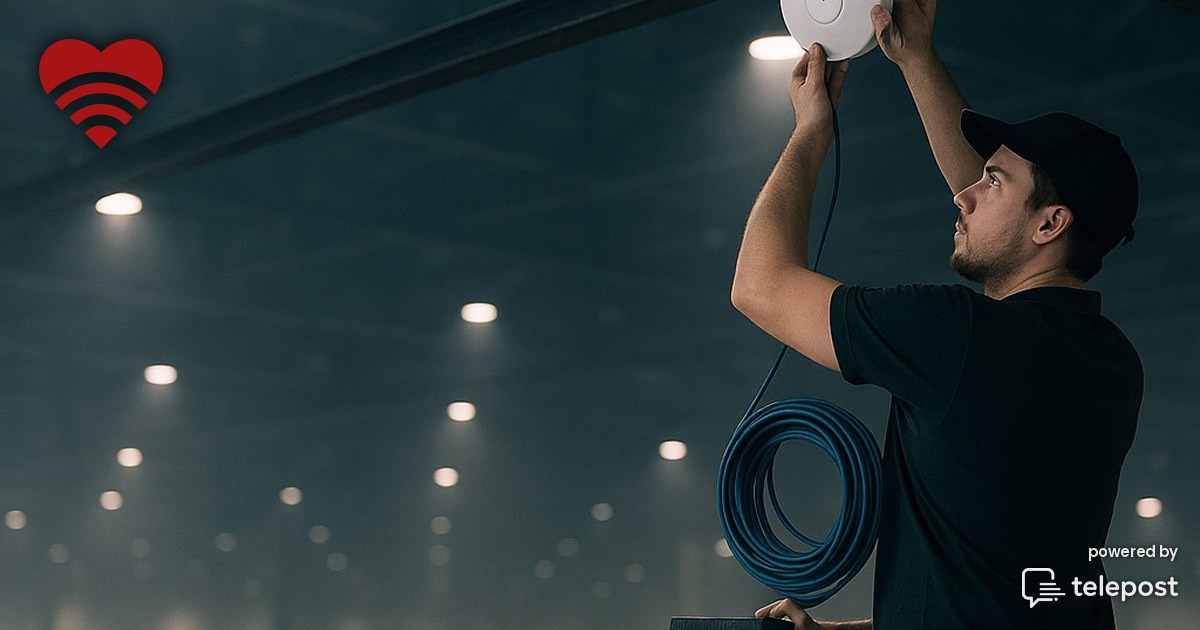
Usually, what happens, unfortunately, is that it is the event director who gets the phone call. People assume the event director is the coordinator for everything, so the complaint lands there first, whether or not that person has any control over the access points in the ceiling. (An access point is the physical Wi-Fi radio mounted overhead, the thing attendees are actually connecting to.)
That means it is incumbent on the event director to make sure they have an IT team set up to handle that type of load, before the doors open rather than after. This is a procurement and planning decision, not a technical one, and it gets made weeks earlier than most people think.
Passpoint: getting 2,000 people online without a help desk queue
Passpoint is an industry standard that lets a phone join a Wi-Fi network automatically, using credentials it already has, from a mobile carrier or an identity provider, instead of the user picking a network name (the SSID) from a list and typing in a password.
Passpoint would be essential in something like Social Fest. People can just walk into the room and their phones connect automatically, without hunting for a network or guessing which one has better signal. It lets them use their existing credentials to get on safely and securely. At a festival that matters twice over: the onboarding experience is the first thing an attendee touches, and the help desk queue is the first thing that tells you the network is failing.
Who pays for event Wi-Fi?
That largely depends. Sometimes the festival springs for it. If they do not have enough money, it is usually the location or the convention center providing it. In this case, it was the City of Mission when they did it last year, so it really comes down to the venue and what the venue already owns.
The honest answer is that nobody has a standing budget line for it, which is exactly why the question gets settled late, and late is when it gets expensive.
The 6 GHz gap sits in the ceiling, not in the audience's pockets
6 GHz is the newest slice of radio spectrum opened up for Wi-Fi. Think of it as extra lanes of highway: more room, less congestion, better suited to a lot of devices moving a lot of data at once.
If you ask what percentage of the phones in that room could already use 6 GHz, the answer is probably all of them. This is a crowd that thrives on the latest hardware, the newest phones, the newest tablets, whatever shipped most recently. The part that may not support it is the venue. That is where the spectrum problem actually sits: in the ceiling rather than in the attendees' pockets.
Some of that is budget constraints. Some of it is simply where the equipment sits in its lifecycle, gear gets replaced on a schedule, not on demand. A good deal of it is that there has been no truly compelling reason to change. And the rest is that people just are not technology aware, so the gear in the room stays a generation or two behind the gear the audience walks in with.
It is a problem that could be resolved easily enough, because the venue can upgrade its equipment to support the latest standards. If you are a building that hosts events where the latest and greatest tech is on display, and that tech is the featured use case of the audience attending, maybe that is the thing worth focusing on when the refresh cycle comes around.
What to do, and what to ask
- Design the festival network for capacity first and coverage second, because the room will be uploading, not scrolling.
- Deploy Passpoint so attendees' phones join automatically on credentials they already have, instead of hunting for a network name.
- If you are the event director, stand up an IT team that can handle that kind of load, you are the one getting the phone call regardless of who owns the equipment.
- Settle early who is providing the network, the festival or the venue, rather than assuming the convention center has it covered.
- Push the venue to support 6 GHz, because the devices in the room can already reach it and the building often cannot.
Questions worth putting to your venue or your network provider in writing:
- How many simultaneous uploading devices is this design built for, and what number was used in the calculation?
- Do the access points in this room support 6 GHz, and if not, when is the refresh scheduled?
- Does the system automatically re-tune channels and power during the event, and can that behavior be frozen or constrained during keynotes and peak moments?
- Is Passpoint available here, and if not, what is the onboarding path for two thousand attendees in the first thirty minutes?
- Who owns and staffs the network during show hours, and who exactly do I call at 2pm on day two?
- Whose budget is paying for this, the festival's, the venue's, or the city's, and is that agreed in writing yet?
Want this kind of thing weekly, in audio? That's the show.